



Can a Storage Pod Be Placed on a Residential Street?
What to Know Before Scheduling Portable Storage Delivery
Portable storage containers are convenient for moving, remodeling, downsizing, and temporary storage, but not every property has enough driveway space for one. Homeowners with narrow driveways, shared parking areas, or limited access may wonder whether a portable storage container can simply be placed along the street.
In many communities, street placement is possible only when local rules allow it. A storage pod street permit, temporary-use permit, or other approval may be required before a container occupies a public roadway. Local restrictions can also determine how long the container may remain, where it can be positioned, and whether reflective markings or other safety measures are necessary.
Mini Storage on Wheels provides portable storage containers for moving and storage throughout Northern California. Before delivery, customers should confirm that the proposed placement area complies with city, county, property-management, and homeowners association requirements.

Can You Place & Keep A Storage Pod on the Street?
Street Placement Depends on Local Regulations
There is no single rule that applies to every residential street. Whether you can put a storage pod on the street depends primarily on who controls the roadway and what temporary-use regulations apply in that community.
A residential street is generally public property rather than part of the homeowner’s parcel. Placing a portable storage container there may therefore be treated differently from placing the same unit in a private driveway.
Some jurisdictions permit temporary containers on residential streets with prior approval. Others impose limitations on placement, duration, dimensions, or traffic clearance. Certain streets may prohibit containers altogether because of parking restrictions, emergency-access requirements, street sweeping, construction activity, or narrow roadway conditions.
Before arranging delivery, contact the appropriate city or county department and explain that you are planning to place a temporary portable storage container within the street or public right-of-way.
When a Permit May Be Required
A Portable Storage Container Permit May Apply to Public Property
A portable storage container permit is more likely to be required when the unit will occupy a street, sidewalk area, parking space, alley, or another portion of the public right-of-way.
Permit requirements differ considerably between communities. Depending on the jurisdiction, the application may ask for:
- – The property address
- – Proposed delivery date
- – Expected removal date
- – Approximate container dimensions
- – Exact placement location
- – Confirmation that traffic will remain unobstructed
- – Proof of insurance in some circumstances
- – Reflective markings or safety devices
- – A permit or application fee
Do not assume that a permit issued for a moving truck automatically covers a portable storage unit. Cities may classify temporary containers differently.
Apply For the Permit Before the Container Is Delivered
If your city requires a permit, obtain approval before scheduling street placement.
Waiting until delivery day can create problems if the driver arrives and the proposed location is not permitted. In some jurisdictions, improperly placed containers can result in citations, removal orders, or additional fees.
Allow additional time when planning a move because permit processing may not be immediate.

Driveway vs. Street Placement For Your Storage Unit?
A Private Driveway Is Often the Simpler Option
When adequate space is available, driveway placement is generally easier because the container remains on private property.
A driveway can also provide several practical advantages. You may have easier access to the storage unit, less exposure to passing traffic, and fewer concerns about occupying public parking spaces.
However, homeowners should still consider storage pod driveway rules before delivery. Driveways need sufficient width, length, overhead clearance, and surface strength for safe placement.
Check for:
- – Low tree branches
- – Power or communication lines
- – Sloped surfaces
- – Gates and fences
- – Sprinklers
- – Vehicles blocking access
- – Narrow turns
- – Garage access
- – Drainage areas
The delivery area should be reasonably level and accessible to the equipment used to place the container.
Street Placement Requires Additional Planning
A street may offer more room, but it introduces concerns that do not usually apply to private driveway placement.
The unit should not block intersections, fire hydrants, driveways, accessible parking areas, traffic signs, sidewalks, or emergency routes. Local agencies may also have rules governing how far a container must remain from a corner or other roadway feature.
A container should never be positioned in a location that creates a visibility problem for drivers, cyclists, or pedestrians.

HOA and Neighborhood Restrictions For Portable Storage Units
Private Communities May Have Their Own Storage Pod Rules
City approval does not necessarily mean your homeowners association will permit the same placement.
HOAs, condominium associations, apartment communities, and managed residential developments may establish separate rules concerning portable storage containers.
Restrictions may address:
- – Whether containers are allowed
- – Driveway placement
- – Street placement within private communities
- – Maximum rental duration
- – Approved delivery hours
- – Container appearance
- – Guest parking
- – Common-area access
If you live in an HOA community, review your governing documents or contact the property manager before delivery.
Some associations may require written approval even when the container remains entirely within your driveway.
How to Prepare the Delivery Area
Measure Before Delivery Day
A few measurements can prevent significant difficulties when the container arrives.
Determine the approximate length and width of the available area and consider the space necessary for delivery equipment to approach the property.
The route should also be clear of parked vehicles, landscaping, construction materials, basketball hoops, temporary signs, and other obstacles.
If your container will be placed along the street, reserve the approved space as permitted by local rules rather than assuming that neighboring vehicles will move before delivery.
Think About Access During the Rental Period
The best placement location is not always the closest available space.
Consider how you will open the container doors, carry furniture to and from the unit, and reach stored belongings after loading begins. Avoid positioning the container where normal household activities will become unnecessarily difficult.
If you are using portable storage during a move, think about both the loading process at your current property and access requirements at the destination.
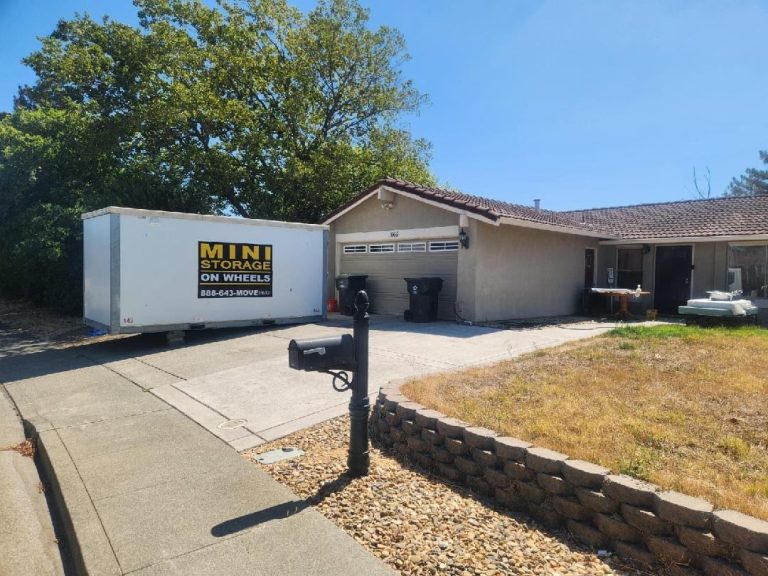
Planning Portable Storage in Napa, Sonoma & the East Bay
Check the Rules for Your Specific City
Portable storage regulations can differ from one Northern California community to the next.
A homeowner in Napa may face different requirements from someone in Sonoma County, Fairfield, Antioch, Concord, or another East Bay community. Even neighboring cities can have different permit applications, right-of-way regulations, and time limits.
Before arranging street placement, check with the municipality responsible for the property address. County rules may apply in unincorporated areas.
You should also determine whether the street itself has special restrictions. Areas with permit parking, narrow roads, street-sweeping schedules, schools, fire lanes, or heavy traffic may have additional limitations.
Mini Storage on Wheels serves communities throughout Northern California. Visit our service areas to learn more about portable storage availability near your property.
Portable Storage Delivered To You
Plan the Placement Before Your Container Arrives
Choosing the right location for a portable storage container can make moving, remodeling, and temporary storage considerably easier.
Mini Storage on Wheels provides insulated 8×16 portable storage containers that can be delivered directly to residential and commercial properties. Containers can remain on-site when appropriate, giving customers convenient access while they pack, renovate, organize, or prepare for a move.
Before delivery, make sure the placement area is accessible and confirm any applicable city, county, HOA, or property-management requirements.
If street placement is necessary, obtaining approval in advance can help prevent delays on delivery day.

Need a Portable Storage Container Near You?
Whether you are preparing for a local move, renovating your home, downsizing, clearing out a property, or simply need temporary storage space, Mini Storage on Wheels can help you plan a practical container delivery around your schedule and property layout.
Our insulated 8×16 portable storage containers are delivered directly to your home or business, giving you convenient access while you pack, organize, remodel, or prepare for your next move. Depending on your location and available space, the container may be placed in a driveway or another approved area on the property. If street placement is necessary, it is important to confirm any city, county, HOA, or neighborhood requirements before delivery.
Planning ahead can make the process considerably easier, especially when space is limited or local permit rules apply. Our team can help you review delivery access, discuss placement considerations, and determine which portable storage option fits your project.